


Falcon Trading Systems has been building decade-class workstations since 2004, long before the first Bitcoin block was mined. In that time, we’ve observed a consistent pattern: crypto traders learn the hard way that consumer hardware engineered for 4-hour gaming sessions, or light browsing and document editing fails when asked to maintain WebSocket connections to Binance, Coinbase Pro, and Kraken simultaneously for 8,760 hours per year.
This guide examines the hardware specifications that distinguish a purpose-built crypto trading workstation from consumer hardware repurposed for a market environment those systems were never designed to survive.
24/7 Constraint Defining Crypto Hardware
The cryptocurrency market never closes. While equity traders experience weekends and the 4:00 PM closing bell, crypto markets operate 24/7/365—through holidays, through volatility spikes, through the night while you sleep. Your hardware doesn’t receive a scheduled maintenance window.
By 2026, the distinction between a consumer desktop with extra monitors and a purpose-built crypto trading workstation carries material consequences: positions, API connectivity during liquidation cascades, and the sustained uptime required to run automation bots without memory leaks or thermal events resulting in a throttled system.
This guide is a practical specification reference. Here is how to select a crypto trading computer in 2026 that performs as infrastructure rather than a liability.
Threads for Automation, Clock Speed for Execution
Crypto trading in 2026 is increasingly automated. Whether you’re running Python-based arbitrage bots, Node.js market makers, or managing 40+ browser tabs across multiple exchanges, you need both multi-core throughput and sustained single-thread clock speed.

|
Tier |
Specification |
Rationale |
|---|---|---|
|
Minimum (2026) |
8-core/ |
Supports concurrent exchange connections and basic optimization |
|
Professional Standard |
12-core/ |
Handles backtesting alongside live execution |
Why single-thread speed matters for crypto: Exchange APIs are single-threaded processes. When Binance transmits a liquidation cascade, your bot’s response time depends on single-thread clock speed—not core count. Multi-core parallelism becomes the binding constraint when backtesting strategies across years of tick data.
Falcon Testing Validation Standard: We validate specific CPU steppings for sustained all-core operation without thermal throttling. This distinction is absent in consumer hardware, where boost frequencies are advertised but thermally unsustainable across continuous operation.
For platform-specific CPU recommendations, see our Best Processor for Trading Computer guide, or contact our specialists for configuration advice tailored to your exchange stack and automation requirements.
Browser Workspace and Data Integrity
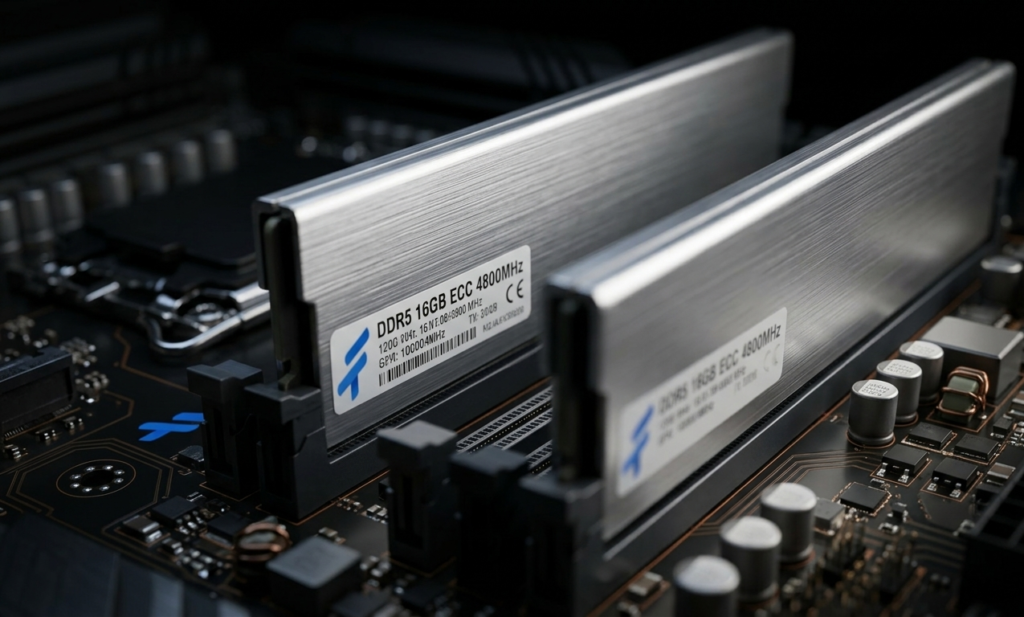
Crypto traders are intensive browser users. TradingView, multiple exchange dashboards, portfolio trackers, communication feeds, and on-chain analytics tools consume RAM differently than traditional trading platforms—and they run continuously.
|
Tier |
Specification |
Rationale |
|---|---|---|
|
Minimum (2026) |
32GB DDR5 |
Supports multi-exchange dashboards and active automation |
|
Professional Standard |
64GB DDR5 ECC |
Data integrity for unsupervised automated strategies |
The ECC Imperative: In consumer hardware, a RAM error during routine operation produces a visual artifact. During an API trade execution, the same error can corrupt order parameters. Error-Correcting Code (ECC) memory detects and corrects single-bit errors in real time, making it an essential specification for automated strategies running without direct supervision.
Node Operators: If you are running local blockchain nodes (Bitcoin Core, Ethereum validators), add 32GB additional RAM per node to the baseline above.
Our article: How much RAM do you need for trading? covers configuration considerations in detail.
Endurance Over Raw Capacity
Consumer SSDs are rated for 0.3–0.5 DWPD (Drive Writes Per Day). A crypto trading workstation logging tick data, maintaining local databases for backtesting, and continuously writing bot execution logs can exceed these ratings. Consumer drives have failed in crypto trading environments in as little as 5–10 months under sustained write load.

|
Specification |
Requirement |
|---|---|
|
Endurance Rating |
High-endurance or enterprise NVMe |
|
Minimum Capacity |
1TB for automated workflows |
|
Recommended Configuration |
Seperate OS and Data drives |
Our article: How Large of an SSD Do You Need for Trading examines current and future storage requirements across trading workflows.
The Tick and API Stability Layer
Crypto trading depends on WebSocket connection integrity. A dropped connection during high-volatility intervals produces missed fills and stale order book data. Network hardware is where consumer compromises carry direct execution cost.
**Consumer Failure Point:** Consumer NICs prioritize throughput over latency consistency—an inappropriate trade-off for tick-sensitive order entry.
**Professional Specification:** Intel I210/I225 server-grade NICs with interrupt coalescing disabled, connected directly to the router via hardwired Ethernet. Wi-Fi is not suitable for primary trading connectivity under any conditions.
**2026 Redundancy Standard:** Dual-NIC configurations—primary fiber or cable connection and backup 4G/5G USB modem with automatic failover—eliminate the single-point-of-failure that terminates automated sessions during ISP outages.
*Configuration Note: Falcon systems ship with Wi-Fi capability for troubleshooting and environments where hardwired Ethernet is not available. Even high-performance Wi-Fi introduces latency orders of magnitude above a standard Ethernet connection. Hardwire your primary trading connection.*
For a detailed analysis of internet specifications and connectivity trade-offs, see [Choosing the Right Internet Speed for Trading](/internet-speed-day-trading/).
Display Output, Not Hash Rate
You do not need a high-end gaming GPU to trade cryptocurrency. Backtesting and automated tasks require matrix math and compute resources found in professional workstation cards. Only rare compound workloads employ the ray-tracing and 3D rendering capabilities present in consumer gaming cards.

|
Monitor Count |
Recommended Configuration |
|---|---|
|
4 Monitors |
NVIDIA T600 or workstation-class cards |
|
6-8 Monitors |
Dual T600 configuration or step up to more capable workstation cards depending on display count and compute requirements |
|
10+ Monitors |
Triple T600 configuration or step up to higher density workstation cards determined by compute requirements |
Consumer gaming cards introduce unnecessary thermal load in continuous 24/7 operation. Sustained heat output degrades component longevity and performance, a compounding cost across the multi-year service life of a trading workstation.
See What Is the Best Graphics Card for Your Trading Computer for detailed configuration guidance.
Desktop vs. Laptop for Crypto Trading
For fixed-location crypto trading, a desktop workstation is the appropriate platform. Thermal physics, expandability, and multi-monitor support converge in the desktop form factor in ways that mobile hardware cannot replicate.
If portability is an operational requirement, a trading laptop is a viable alternative. The trade-off is material:
Processing power: Desktop systems sustain higher clock speeds and all-core performance across extended operation. Most laptops do not replicate this under thermal constraints.
Monetary Cost: Mobile configurations are more expensive than equivalent desktop workstations. Performance is negatively affected by thermal capacity.
Monitor support: Desktops support more displays from the outset and can be expanded after purchase. Laptops cannot.
Portability: Laptops permit location flexibility where a power source is available, the most convenient choice for traders who require mobility.
Evaluate portability as an operational requirement, not a preference. The performance cost of the mobile form factor is real and sustained across every trading session.
Pre-Purchase Verification Checklist
Before purchasing any crypto trading computer in 2026, confirm:
- 24/7 operation rating: Is the system validated for continuous duty, not gaming or short-burst performance?
- ECC memory: Does it employ error-correcting RAM for data integrity during automated order execution?
- SSD endurance rating: Are drives specified for enterprise endurance (1–3+ DWPD) rather than consumer rated loads?
- Warranty duration: Is the warranty 5 years? Warranty length should cover the system's continuous-duty maintenance window (4-yr cycle minimum).
- US manufacturing: Is it built domestically? US manufacturing provides component traceability relevant to tax and compliance documentation. Falcon builds every system in Laramie, Wyoming.
- Lifetime support: Does the manufacturer provide USA-based lifetime phone support? Cryptocurrency markets evolve continuously; your support relationship should match that horizon.
Service, Support, and the Long Game
Technical issues are not a matter of if, they are a matter of when. The relevant question is what support infrastructure exists when they occur. Examine the warranty before purchasing or building any system. A 1-year warranty on a computer or component you intend to operate 24/7 for multiple years is not a warranty, but effectively a countdown.
Falcon’s 5-year warranty and lifetime phone support exist because we build systems intended to remain in service through multiple market cycles. Our 60% annual repeat customer rate substantiates that record. Our technicians routinely help customers get systems built more than a decade ago back up and running with no labor dollar cost.
Build for the Cycle
Even to today, cryptocurrency markets operates in 4-year cycles. The workstation you deploy in 2026 needs to perform through the 2028 halving, through the volatility of 2029, and into 2030 without degradation.
Consumer hardware is engineered for planned obsolescence, GPU generations every 18 months, low quality thermal paste drying after two years, replacement cycles that serve the manufacturer more than the operator. A crypto trading workstation should function as invisible infrastructure: operating reliably for a decade while you focus on execution.
The best crypto trading computer for 2026 is not the one with the highest “benchmark” score. It is the one that sustains your API connections at 3:47 AM on a Sunday when Ethereum drops 12% in three minutes, your automation needs to execute, and you need to sleep.
FAQ
Is a crypto trading computer different from a regular trading computer?
The hardware specifications overlap substantially, but the operating profile is distinct. Equity and futures traders work defined market hours with scheduled downtime. Crypto traders operate 24/7/365, which imposes continuous-duty requirements on every component — thermal management, storage endurance, RAM data integrity, and network stability. A workstation that performs adequately across 6.5-hour equity sessions may exhibit thermal throttling, memory errors, or storage degradation under continuous cryptocurrency operation.
Do I need ECC RAM for crypto trading?
For manual trading across browser dashboards, standard DDR5 is sufficient. For automated strategies running without direct supervision, ECC (Error-Correcting Code) memory is an essential specification. A single-bit memory error during API order execution can corrupt order parameters. ECC detects and corrects these errors in real time — the margin between a correct fill and a corrupted one is not a trade-off worth optimizing away.
What GPU do I need for a crypto trading computer?
For display output across 4–6 monitors with exchange dashboards and charting software, a professional workstation card such as the NVIDIA T600 is appropriate. It delivers reliable DisplayPort signal integrity, draws approximately 40W under load, and operates near-silently — all relevant for 24/7 continuous operation. Consumer gaming GPUs introduce unnecessary thermal load and power consumption without providing meaningful benefit for standard crypto trading workflows.
Can I use Wi-Fi for crypto trading?
Wi-Fi is not suitable for primary trading connectivity. Even high-performance Wi-Fi introduces latency orders of magnitude above a hardwired Ethernet connection, and connection stability under high-throughput conditions is inferior to a wired link. WebSocket connections to exchanges require sustained low-latency connectivity — a dropped connection during a volatility spike produces stale order book data and missed fills. Hardwire your primary trading connection; reserve Wi-Fi for secondary or troubleshooting purposes.
Desktop or laptop for crypto trading?
A desktop workstation is the appropriate platform for fixed-location crypto trading. Thermal physics constrain laptop processors from sustaining the clock speeds a desktop delivers across extended operation. Desktop configurations also support more monitors, greater RAM capacity, and component-level maintainability that extends service life. If portability is an operational requirement, a trading laptop is viable — but the performance trade-off is real and sustained across every session.
Do I need a VPN for crypto trading?
VPNs provide privacy and security benefits for traders concerned with order transmission through public internet infrastructure — but they introduce latency and routing complexity that warrants evaluation before deployment in a primary trading configuration. A VPN that adds 20–50ms of round-trip latency to exchange API calls is a meaningful execution cost. For a detailed examination of when VPN use supports trading operations and where it introduces execution risk, see our [VPN for Trading](/vpn-trading/) guide.
What warranty should I look for on a crypto trading computer?
A minimum of 5 years, from a manufacturer that builds for continuous duty. A 1-year warranty on a system you intend to operate 24/7 reflects consumer-grade engineering assumptions, not professional workstation standards. Falcon’s 5-year warranty and lifetime phone support exist because our systems are built to remain in service through multiple market cycles — not to be replaced on a consumer upgrade schedule.
Configure Your 24/7 Crypto Workstation
Configure Your Falcon Workstation
Falcon Preferred Configs are Prepared to Ship
Or speak with a specialist directly—lifetime U.S. phone support—1-800-557-7142
Falcon Trading Systems has manufactured professional trading workstations in Laramie, Wyoming since 2004. Our systems operate in proprietary trading firms, hedge funds, and retail operations worldwide, validated for continuous duty across market conditions no benchmark was designed to simulate.

