


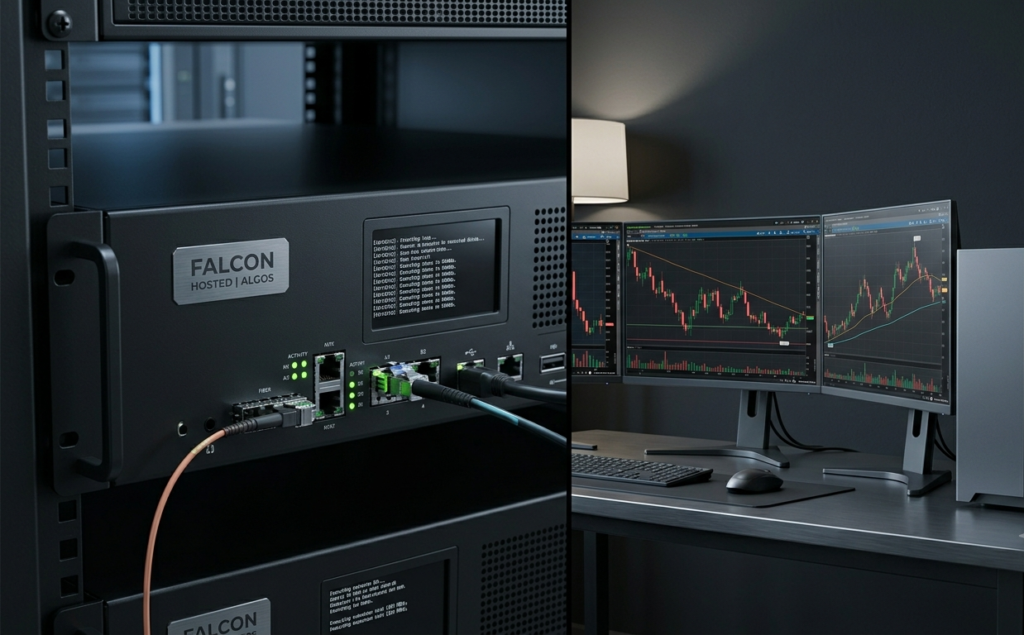
Your bot executes on a VPS parked three server racks from the exchange. The strategy was backtested across 10,000 bars. But when the algorithm exits a position prematurely and you cannot determine why because your local system lacks the compute resources to run the same analysis in parallel, the geographical proximity of your VPS provides no benefit.
A VPS is a tool with a specific function in the trading stack. Its utility depends entirely on whether your trading is automated or manual.
What a VPS Does for a Trading Operation
A Virtual Private Server provisions dedicated compute resources in a data center, operating independently of your local workstation. For trading, it offers two structural advantages:
- Geographic proximity to exchange servers: Placing execution infrastructure near matching engines reduces round-trip latency for automated order submission
- 24/7 operation independent of local system status: Automated strategies continue executing when your local workstation is offline, undergoing maintenance, or disconnected
These capabilities serve precisely one category of trading: automated strategy execution. For manual traders, neither advantage applies.
Automated Use
Traders running Expert Advisors on MetaTrader, algorithmic strategies on NinjaTrader, or customized execution scripts benefit from VPS deployment. The VPS maintains continuous platform operation, executes trades based on predefined rules, and sustains connectivity regardless of local system state.
The platform-specs reference for MetaTrader explicitly notes this consideration: “For 24/7 EA operation, local hardware less critical.” This is the narrow band where VPS substitution is valid — fully automated execution with no requirement for local intervention.
Traders deploying automated strategies across multiple instruments or timeframes particularly benefit. A VPS eliminates the dependency on local workstation uptime and mitigates the risk of missed executions during non-trading hours.
Manual Trading Through a VPS
Manual trading through a VPS introduces latency between the trader and the market that does not exist with a direct connection. The data path becomes:
Your Input → Local System → VPS → Exchange
Instead of:
Your Input → Local System → Exchange
Every routing hop adds milliseconds. The VPS introduces server processing overhead and additional network distance even when geographically proximate to the exchange, because your physical location is not proximate to the VPS.
The latency analysis from our internet connectivity guide establishes that day trading requires under 50ms round-trip time, and every additional millisecond degrades execution quality. The VPN trading guide’s slippage mechanics apply identically here: additional latency for manually placed orders increases the probability that price moves against your position before execution reaches the exchange.
For manual traders, a VPS does not improve anything. It degrades the one variable, execution latency, that local hardware optimization directly improves.
Cost Calculations
|
Variable |
Local Workstation |
VPS + Local Workstation |
|---|---|---|
|
Execution Path |
Direct to exchange |
Routed through VPS |
|
Manual Trade Latency |
Base (optimal) |
Base + 10-50ms |
|
Slippage Risk |
Minimal |
Elevated |
|
Automated Strategy Latency |
Equal to Manual Orders |
Lower than Manual Orders |
The incremental latency from VPS routing imposes measurable cost through slippage on market orders and missed fills on limit orders, the identical cost function documented in the VPN analysis. For manual traders, there is no scenario where VPS routing improves execution quality.
The Complete Workflow
Even for traders whose strategies benefit from VPS execution, the local workstation remains the operational center of the trading operation. The VPS handles one function; the local system handles everything else.
Strategy Development
Algorithms and EAs are written, compiled, and tested on local hardware. No trader develops strategies through a remote desktop session to a VPS. The local workstation provides the development environment, version control, simulation tools, and the low-latency interface required for effective code iteration.
Backtesting
Historical simulation requires substantial compute resources — processors optimized for single-threaded calculation, substantial RAM for market data loading, and fast NVMe storage for tick data access. These specifications mirror the requirements of active trading and are met by a professional-grade workstation, not by standard VPS configurations.
The Falcon F-52GT, designed for backtesting and algorithmic trading workloads, exemplifies the specifications required: high-clock-speed processors, substantial DDR5 memory, and enterprise-grade storage. A $30/month VPS does not approximate these capabilities.
Real-Time Monitoring and Risk Management
The trader monitors strategy execution through local software — dashboards, platform instances, risk management overlays. When an algorithm behaves unexpectedly, the trader intervenes from the local system. Without local compute power to run monitoring tools alongside analysis software, the trader operates blind.
Parallel Analysis
When a running strategy exhibits anomalous behavior, the trader needs to analyze the same market data locally — running alternative indicators, testing modified parameters — without disrupting the live execution on the VPS. This requires simultaneous local computation. A minimal local system incapable of running the same analysis creates operational dependency on the VPS, eliminating the trader’s ability to diagnose and respond.
Cost Analysis
The VPS discussion frequently reduces to cost: “Why buy a $3,000 workstation when I can rent a $30/month VPS?”
This framing misunderstands the architecture. The VPS does not replace the workstation. It supplements it. The correct comparison is:
|
Approach |
Hardware |
Monthly Cost |
Total 5-Yr Cost |
|---|---|---|---|
|
VPS-Only |
None |
$30-200+ VPS |
$1,800-12,000+ |
|
VPS & Workstation |
Falcon Workstation |
$30-200+ VPS |
$3,700-17,000+ |
|
Workstation-Only |
Falcon Workstation |
$0 |
$1,900-5,500+ |
A Falcon workstation carries a 5-year warranty and lifetime phone support, engineered for decade-class service — a standard reflected in our 60% annual repeat customer rate and 20-year service history. The VPS subscription renews indefinitely with no equity accumulation. The workstation is a capital asset; the VPS is an operating expense.
For the automated trader, the correct architecture includes both. The VPS executes; the workstation enables the trader to develop, test, monitor, and improve the strategies the VPS runs.
FAQ
Do I need a VPS for trading?
Only if you run automated strategies requiring 24/7 operation and geographic proximity to exchange servers. Manual traders derive no benefit from VPS and incur additional latency costs. Algorithmic traders benefit from VPS execution but still require a capable local workstation for strategy development, backtesting, and monitoring.
Can I trade manually through a VPS?
Manual trading through a VPS adds 10-50ms of latency to every order — the same cost function as VPN routing. This latency increases slippage on market orders and produces missed fills on limit orders. Manual trading through a direct local connection provides superior execution quality.
What hardware do I need for algorithmic trading?
Algorithmic trading requires a workstation capable of strategy development, backtesting, and real-time monitoring. Specifications include a high-clock-speed processor for single-threaded platform performance, 32-64GB DDR5 RAM for multi-platform operation, and NVMe storage for market data access. The Falcon F-52GT is configured for these workloads.
VPS vs. dedicated server for trading — which is better?
A VPS suffices for most retail algorithmic trading. Dedicated servers become relevant for institutional trading volumes, multi-strategy deployment requiring substantial compute, or regulatory requirements. For the majority of automated retail traders, a VPS paired with a capable local workstation represents the appropriate architecture.
Can I run MetaTrader EAs on a VPS?
Yes. MetaTrader 4 and 5 EAs operate effectively on VPS infrastructure for 24/7 execution. MetaTrader’s relatively lightweight resource requirements make it well-suited for VPS deployment. Your local workstation should still handle EA development, backtesting, and performance monitoring.
Does a Falcon workstation support algorithmic trading workflows?
Falcon workstations are engineered for sustained performance under continuous computational loads. The F-52GT and F-1 BLUE ICE models provide the processor, memory, and storage specifications that automated strategy development requires, with 5-year warranty coverage and lifetime technical support.
Configure Your Trading Computer
Configure Your Strategy-Aligned Workstation
Explore Falcon Preferred Professional Configurations
Learn About Our 5-Year Warranty
Or call our specialists: 1-800-557-7142 — U.S. Based Lifetime Support —

