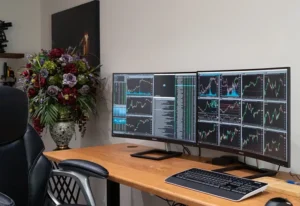
Your desktop is not a passive component in your trading operation. It is the infrastructure that determines whether your platform renders tick data without latency, whether your backtesting completes before the next session opens, and whether sustained 6.5-hour market days degrade performance or maintain it. Choosing incorrectly means re-buying in 24 months. Choosing correctly means deploying capital once and trading on that investment for a decade.
This guide is a complete reference for selecting a desktop trading computer in 2026. It covers every Falcon desktop model, the engineering rationale behind each component decision, platform-specific hardware requirements, and the total-cost-of-ownership framework that separates professional workstations from consumer hardware.
The Desktop Advantage in 2026
The desktop form factor persists in professional trading because thermal physics and expandability are not negotiable. A desktop tower provides the thermal headroom to sustain processor turbo frequencies across an entire market session. It accommodates full-size workstation graphics cards with multiple display outputs. It supports storage arrays, RAM expansion beyond mobile constraints, and component-level maintainability that extends service life.
Mobile trading serves a genuine need: portability. But for fixed-location trading where execution quality correlates with hardware stability, the desktop remains the appropriate platform. The 2026 Intel Core Ultra architecture, combined with Arctic Storm Phase Change Cooling, sustains maximum clock speeds on every core without thermal throttling—a engineering outcome no mobile form factor can replicate.
Every Falcon desktop is built in Laramie, Wyoming, with component traceability from source to shipment. The 20-year service history and 60% annual repeat customer rate substantiate an engineering philosophy: build systems that outlast strategy iterations.
2026 Falcon Desktop Lineup Overview
|
Model |
Starting Price |
Best For |
|---|---|---|
|
P-32 |
$1,965 |
Exchange Floors |
|
F-37GT |
$2,300 |
Active Day Trading |
|
F-52GT |
$2,895 |
Backtesting |
|
F-1 Blue Ice |
$3,785 |
Zero-Compromise Backtests |
Processor
The 2026 desktop lineup continues to consist almost entirely of Intel Core Ultra processors. The P-cores handle single-threaded platform execution—the predominant workload pattern for ThinkOrSwim, NinjaTrader, TradeStation, and TWS. The E-cores manage background tasks, operating system overhead, and data caching without competing with P-core resources. For backtesting workloads that benefit from AMDs throughput, we offer the F-52GT and F-1 systems with AMD processor variants.
Platform-Specific CPU Requirements
|
Platform |
CPU Usage |
Binding Constraint |
Falcon Recommendation |
|---|---|---|---|
|
ThinkOrSwim |
Single Threaded |
Clock Speed |
F-37GT |
|
NinjaTrader |
Multi-Threaded |
Multi Core + Clock Speed |
F-52GT, F-1 Blue Ice |
|
TradeStation |
Multi-Process 32-bit |
More Indicators: Clock Speed |
More Indicators: F-37GT |
|
TWS (IB) |
Single-Threaded |
Clock Speed |
F-37GT |
|
TradingView |
Browser Dependent |
Desktop: Core Count |
Desktop: F-37GT |
|
MT4/5 |
Multi-Process |
Core Count |
F-52GT, F-1 Blue Ice |
The P-32 introduces the Core Ultra 5 245K with 14 cores and 5.50 GHz turbo, sufficient for single-platform trading at the accessible $1,965 entry point. The F-37GT elevates to the Ultra 7 265K with 20 cores and 5.50 GHz turbo, endorsed by record-holding trader Dan Zanger. The F-52GT and F-1 BLUE ICE both deploy the Ultra 9 285K with 24 cores and 5.7 GHz turbo, the ceiling for single-threaded trading performance in 2026.
The F-52GT Preferred ships same-day with the Ultra 9 285K pre-configured, eliminating customization lead time while delivering maximum clock-speed capability.
Memory
Trading platforms consume memory proportionally to monitor count, indicator complexity, and concurrent platform instances. The 2026 standard across Falcon desktops is DDR5 memory, with no overclocking. Voltage optimized factory-rated modules validated for stability during extended operation.
|
Model |
Base RAM |
Maximum |
Use Case |
|---|---|---|---|
|
P-32 |
16GB DDR5 |
64GB |
Single-Platform, Position Trading |
|
F-37GT |
16GB DDR5 |
64GB |
Active Trading, Single Threaded Platforms |
|
F-52GT |
16GB DDR5 |
64GB |
Backtesting, algo trading, multi-platform |
|
F-1 Blue Ice |
16GB DDR5 |
128GB CUDIMM |
Demanding Workloads & Backtesting |
Per-monitor memory consumption averages 0.5 GB baseline, escalating to 1–1.5 GB with complex indicators and tick charts. Platform memory leaks across extended uptime effectively double the requirement. The 96 GB configuration in the F-52GT addresses the power-user segment running ThinkOrSwim, NinjaTrader, and TradingView concurrently while performing backtesting operations.
For the full analysis of memory consumption by trading workload, see our RAM specification guide.
Storage
Every Falcon desktop ships with NVMe Gen 4 solid-state storage, delivering 5,000–7,000 MB/s sequential read throughput. This bandwidth saturates any trading platform’s data access requirements. PCIe 5.0 drives at 10,000 MB/s provide no measurable improvement in platform load times or chart cache retrieval for trading applications.
|
Model |
Base Storage |
Maximum Configuration |
|---|---|---|
|
P-32 |
500GB |
2TB SSD, 4TB HDD |
|
F-37GT |
1TB SSD |
2TB SSD, 4TB HDD |
|
F-52GT |
1TB SSD |
4TB SSD, 4TB HDD |
|
F-1 Blue Ice |
1TB SSD |
4TB SSD, 4TB HDD |
The F-52GT Preferred presents a dual-storage architecture: 2 TB NVMe Gen 4 for active platform installation and data caching, with a 4 TB HDD for system backup. This aligns with our storage position: image backup software (Paragon) provides superior data protection to RAID for retail trading environments.
Never defragment SSDs. Fragmentation benefits NAND wear distribution. Our storage guide details the complete maintenance protocol.
Graphics Cards
Desktop trading workstations require display bandwidth and driver stability, not 3D rendering performance. Falcon configures workstation-grade graphics solutions that prioritize multi-monitor support, professional driver certification, and sustained operation temperature profiles.
|
Model |
Base Monitor Support |
Maximum Monitors |
|---|---|---|
|
P-32 |
2 |
8 (configurable) |
|
F-37GT |
2 |
8 (configurable) |
|
F-52GT |
4 |
12 (configurable) |
|
F-1 Blue Ice |
4 |
12 (configurable) |
ThinkOrSwim requires a CUDA-capable GPU (T400, P620, or T600 minimum) for full platform acceleration. Falcon recommends graphic intensive GPU for daytrading with ToS.
TradeStation benefits from moderate GPU acceleration for Options Analysis and Greeks calculations. NinjaTrader, MT4/5, and TWS show no measurable performance difference between workstation and consumer GPUs for chart rendering.
For a detailed examination of the workstation versus gaming GPU question, see our analysis on trading GPUs
Power Supply
Falcon standardizes on 750-watt power supplies across all desktop models. The 12V rail capacity, not headline wattage, determines whether the system delivers stable power under sustained load. All Falcon power supplies utilize Japanese capacitors rated for 105°C operation, with the P-32 and above employing solid capacitors rated for 12,000 operating hours.
The 750W specification provides adequate headroom for current-generation Intel Core Ultra processors and multi-monitor GPU configurations while maintaining the efficiency curve below 80% load—the optimal operating range for power supply longevity.
Cooling
Consumer cooling solutions optimize for peak performance during 2–3 hour gaming sessions. Trading requires 6.5+ hours of sustained operation, five days per week, fifty-two weeks per year. The thermal design must prevent any performance degradation across the entire market session, not just during the first hour.
Arctic Storm Cooling
The P-32, F-37GT, and F-52GT utilize Arctic Storm Cooling. This thermal solution maintains maximum turbo frequencies across multiple Performance cores (P-cores) throughout extended operation. Each system undergoes 72–96 hours of stress testing before shipment, verifying thermal stability under worst-case load conditions.
Custom Liquid Cooling
The F-1 BLUE ICE eliminates thermal throttling entirely with a custom liquid cooling loop. The system employs a 1,000 L/hour D5 pump circulating coolant through copper and nickel surfaces. Unlike All-In-One liquid coolers that approximate high-end air cooling performance, the F-1’s custom loop maintains maximum clock speeds under 300+ watt heat generation with zero thermal compromise.
Decision Framework
- Determine monitor count. This establishes the GPU baseline. Two monitors permit any model. Four monitors require the F-37GT or above. Eight monitors necessitate the F-52GT Preferred or F-1 BLUE ICE with the configurable graphics upgrade.
- Identify primary platform. ThinkOrSwim and TradeStation benefit from higher clock speeds and CUDA-capable GPUs. NinjaTrader and TradingView require less GPU investment. TWS and MT4/5 operate effectively on any Falcon desktop.
- Assess concurrent workload volume. Single platform with standard indicators: P-32 suffices. Two or more platforms with complex indicators: F-52GT with 96 GB RAM serves the power-user segment.
- Evaluate portability needs. Desktop trading presumes fixed location. If any portion of trading occurs away from the primary station, pair the desktop with an F-10 or F-25 laptop for mobile access.
- Apply the decade-class cost framework. The P-32 at $1,965 delivers a lower entry cost than consumer alternatives and exceeds their service life by a factor of three. The F-52GT at $2,895 delivers the highest performance-to-longevity ratio in the lineup. The F-1 BLUE ICE at $3,785 eliminates thermal throttling for traders whose execution quality depends on zero performance variance.
The 2026 Component Selection Framework
When configuring a trading computer for 2026:
1. Select CPU based on clock speed — most platforms are single-threaded (Focus on P-core speed for Intel)
2. 16GB base RAM, 32-64GB professional — 2026 standard across lineup
3. NVMe Gen 4 SSD — 5,000-7,000 MB/s throughput
4. Display engineering focus — workstation GPUs or Hybrid Workstation/RTX configuration
5. 750W PSU standard — 12,000 hour rated capacitors (Not all Watts are the same)
6. Sustained cooling design — Arctic Storm Cooling or custom engineered liquid loop
7. Warranty reflects longevity — 3-5 years parts & labor, lifetime U.S. technical support
Falcon Model Lineup
Falcon Desktop Systems
The P-32 serves exchange floors and cost-conscious professionals with the Ultra 5 245K and 5-year warranty. The most accessible entry point to a Falcon System with Arctic Storm Cooling.
The F-37GT delivers the professional standard. Dan Zanger’s choice features the Ultra 7 265K, 37lbs of technology, 12,000-hour rated capacitors, and 5-year warranty.
The F-37GT Preferred is preconfigured with our trader’s favorite system configuration so you don’t need to sort through the plethora of options. Confirmed orders ship same day*.
The F-52GT represents the most popular choice for speed and reliability. John Carter’s configuration includes the Ultra 9 285K, 96GB DDR5 standard, and 72-96 hour stress testing.
The F-52GT Preferred ships same day with the Ultra 9 285K pre-configured: 64GB DDR5, 2TB NVMe Gen 4, 4TB backup HDD, Windows 11 Pro, and Falcon Process Accelerator Software—maximum configuration without customization delays.
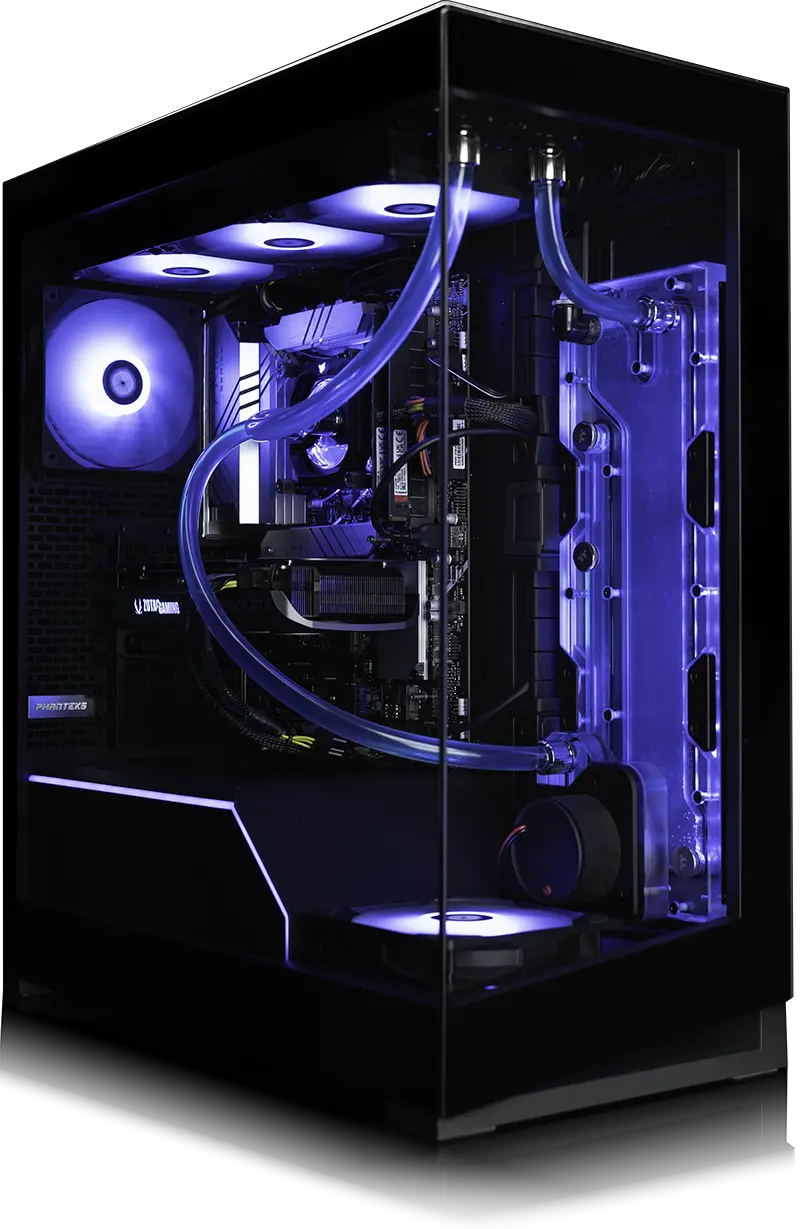
The F-1 BLUE ICE delivers ultimate performance with custom liquid cooling. The Ultra 9 285K never throttles under the 1,000 L/hr D5 pump and copper/nickel loop—premium aesthetics with zero thermal compromise.
Platform Specific Recommendations
ThinkOrSwim (TOS)
F-37GT minimum, F-52GT optimal.
RAM: 32-64GB for multiple instances.
CUDA Requirement: Graphics Intensive configuration option with Falcon’s ThinkOrSwim specific JVM optimizations.

NinjaTrader
F-52GT (high clock speed critical for MarketAnalyzer).
RAM: 32-64GB recommended.
Priority: Clock speed over core count.

Tradestation
F-37GT minimum, F-52GT optimal for EasyLanguage backtesting and RadarScreen.
RAM: 32-64GB for multiple instances.
CUDA Requirement: Our Nvidia workstation cards cover Options Analysis acceleration with no upgrade needed.

TradingView
Browser
P-32 (accessible entry-level) or F-37GT.
RAM: 32GB minimum.
Priority: RAM capacity for multiple browser tabs.
Desktop
F-37GT minimum, F-52GT optimal
RAM: 16GB minimum.
Priority: RAM capacity for multiple browser tabs.

Multi-Platform
F-52GT (96GB RAM handles concurrent platforms).
Priority: RAM capacity dominates other requirements.
FAQ
Is a desktop trading computer better than a laptop for day trading in 2026?
Yes, for fixed-location trading. Desktop configurations deliver superior thermal headroom, higher sustained clock speeds, expandable storage and RAM, and component-level maintainability. Laptops serve mobile trading requirements; desktops serve institutional-grade execution.
What is the best Falcon desktop for a new retail trader?
The P-32 at $1,965. It provides the Core Ultra 5 245K, NVMe Gen 4 storage, configurable graphics up to 8 monitors, and a 3-year on-site warranty, exceeding consumer desktop specifications at a lower total cost of ownership over 10 years.
How much RAM do I need for ThinkOrSwim on a desktop?
32 GB minimum, 64 GB recommended for multiple TOS instances or concurrent platform operation. The F-52GT provides 96 GB standard, covering the most demanding TOS configurations.
Do I need a separate graphics card for multi-monitor trading?
All Falcon desktops support multi-monitor configurations. The base F-37GT supports 2 monitors expandable to 8. The F-52GT supports 4 monitors expandable to 12. Workstation-grade graphics provide appropriate display bandwidth without unnecessary GPU overhead.
What is the difference between the F-52GT and F-52GT Preferred?
The F-52GT is customizable with a 5–10 business day lead time. The F-52GT Preferred ships same day* with a pre-configured specification: 64 GB DDR5, 2 TB NVMe Gen 4 SSD, 4 TB HDD backup, Windows 11 Pro, and Falcon Process Accelerator Software. The Preferred model eliminates customization lead time for traders who require immediate deployment.
Why does Falcon use a 750W power supply across all models?
The 750 watt specification provides adequate headroom for current-generation Intel Core Ultra processors and multi-monitor GPU configurations while maintaining the efficiency curve below 80% load. The 12V rail capacity and Japanese 105°C-rated capacitors, not the wattage figure, determine power delivery stability.
How long should a Falcon desktop trading computer last?
Falcon designs for decade-class service life. The 5-year warranty (versus industry-standard 1-year) and lifetime phone support reflect our engineering team’s confidence in component longevity. The 60% annual repeat customer rate substantiates that traders understand total cost of ownership and return to Falcon when expanding operations.
Can the P-32 run multiple monitors?
Yes. The P-32 supports 2 monitors as standard configuration and is expandable to 8 monitors through configurable graphics upgrades.
The Falcon Difference
The distinction between consumer hardware and a Falcon Trading Computer is not specification sheets. We spend hours testing each system in its final configuration after engineering for sustained operation, display stability, and component longevity.
Each model reflects the component principles outlined in this guide. Customize within the framework to match your specific trading requirements: monitor count, platform selection, portability needs, and budget parameters.
Your hardware should outlast your strategy iterations. Buy once. Trade for a decade.
Configure Your Trading Computer
Configure Your Strategy-Aligned Workstation
Explore Falcon Preferred Professional Configurations
Learn About Our 5-Year Warranty
Or call our specialists: 1-800-557-7142 — U.S. Based Lifetime Support —
* Falcon Preferred system orders ship same day when placed and confirmed via Sales Representative before 3pm MST.